Showing posts with label yam. Show all posts

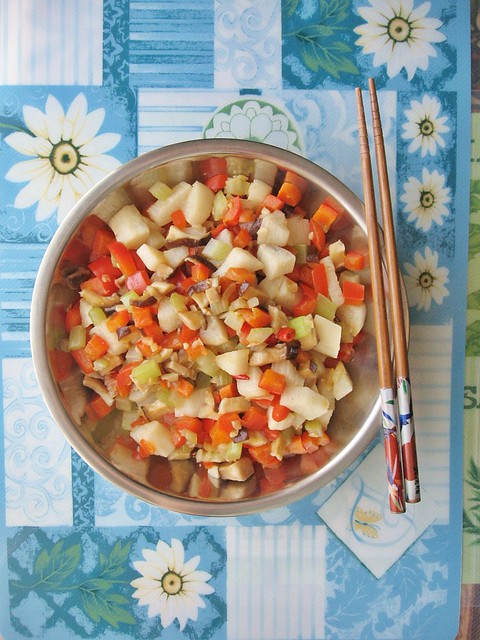
Nagaimo (Mountain Yam) Stir-Fry 清炒山药

If you enjoy the crunch of Chinese water chestnuts (Eleocharis dulcis), then you may also like the crisp texture of Naga-imo (mountain yam) in this vegetarian stir-fry. Nagaimo is a good source of minerals, Vitamin B1, Vitamin C and dietary fiber, in addition to micro-nutrients e.g. choline and saponin.


Some of these nutritive elements are said to help relieve fatigue. In addition, the viscous substance peculiar to the nagaimo is known to help the body make better use of proteins, aid digestion and fight fatigue.

Once the nagaimo hits the hot pan or wok, the sliminess is reduced - just like when boiled in soups, this gluey, almost-mucilaginous consistency is almost gone at the end of cooking. To reduce loss of essential nutrients, nagaimo does not take a long time to cook.

The key to this stir-fry is to add the celery, bell pepper, nagaimo towards the end of cooking (as these three ingredients can be taken raw, so does not need much time to fully cook them), then do a quick high-heat stir-fry to combine all the ingredients and flavors.


Nagaimo (Mountain Yam) Tofu Soup 山药豆腐汤

This is a nourishing one-pot dish packed with proteins (mushrooms and tofu) and fiber (mountain yam - Nagaimo, 山药 and celery) adapted from a TV programme. The show particularly highlighted the benefits of mountain yam - Nagaimo and the host-cum-cook used soy milk (in replacement of water) for the added nourishment, as the cooking broth.


With this substantial one-pot dish that is able to stand as a meal, it can substitute carbs-of-the-day.


Nagaimo Stir-Fry with Bell Peppers, Broccoli Stems and Mushrooms

I deleted more than 10 draft posts (with only titles but no contents) that have been sitting in my drafts folder for the longest time. I have forgotten what I wanted to write about these subject titles. And the longer they stay there, the more lost I get, on what to write about them. D-E-L-E-T-E.


This is a simple stir-fry that I will cut short about the benefits and nutrition of Mountain Yam or Nagaimo) since I have said that before in my other yam recipes.


Nagaimo (Mountain Yam) Chicken Soup - 淮山鸡汤

It is not often that I see edible tuber-llike plants with digestive enzymes such as amylase and diastase that convert starch to sugar and digest carbohydrates. Nagaimo is one of them, also know as Chinese Mountain Yam (山药 Shan Yao, or 淮山 Huai Shan. There is plenty of nutrients in Nagaimo and you should really check them out. When in season, they can be found in Asian Supermarket - Ranch 99, and Japanese Supermarkets - Nijiya and Mitsuwa, in California, USA.


I have done a stir-fry at home before and while I was staying at my friend's place, we also stir-fried these wild yams but it does not seem popular with guys (our husbands) - they do not enjoy the slimy texture! They complained it was weird.

However, when I make soup out of these yams one day ...you know what, hubby did not say anything (a good sign).  He just finished the soup. The sliminess seems to have "dissolved"(disappeared) and  became really subtle when cooked in a soup. Oh, maybe hubby thought he was drinking Chicken and Potato Soup? NO. They are not the same. The "sliminess" in potatoes is starch but the "sliminess" in these yams is definitely NOT starch but mucilaginous property of proteins.


Chinese wild yam, Japanese mountain yam, it is just good stuff!

Dioscoreae Oppositae - its English pharmaceutical name, or commonly Chinese wild yam, you can call it. Its other name - nagaimo, or Japanese mountain yam.

Seen them in Asian supermarkets, especially Japanese supermarkets such as Mitsuwa in the United States, but never tried them in my cooking. Seen them in Taiwan again and decided to have a simple stir fry to this. It's rather common in Taiwan and the people here believe this tuber has beneficial properties. In Mandarin, call it 淮山 ~ pronounced huai shan; or 山药 ~ pronounced shan yao. 山药 literally meaning "medicine of the mountain" - this tuber vegetable indeed has its healing properties. This wild yam even has sexual lubricating characteristics, as documented in Wiki.

Numerous tiny channels in the yam cross-section, are channels that produce the "slime"

This tuber vegetable is starchy and mucilaginous (slimly, gelatinous, sticky) when grated/sliced, and may be eaten plain (esp. those grown in Japan), as a side dish, or added to noodles. Can you see the numerous tiny round channels in the cross-section ? These are channels that produce the "slime". The long tuberous roots are cultivated for pharmaceutical as a superior herb. The dried white flesh of the tuber is sliced into long thin slabs and contains nutrients which can restore and enhance immune functions throughout the system. You can usually find these dried white flesh of thin tuber slabs, packaged with other dried Chinese herbs and sold as a complete Chinese tonic pack. I had a steamed herbal chicken recipe using Chinese dried herbs of dioscoreae oppositae and other herbs before.

Weekend Herb Bloggers, do you know this plant? It's my first attempt at this new ingredient and I hope to share this new learning and insight at Weekend Herb Blogging, returning to Kalyn this week.
Wild yam is known as an anti-inflammatory, a pain reliever and an antispasmodic (relieves muscle spasms). An alternative healing site on traditional Chinese medicine also indicated anti-aging application.

Historically, wild yams have been used to treat menopause symptoms, menstrual cramps, gallstones and muscle spasms. Most species of wild yams can be found growing in most temperate climates in the world. One species of yam, Dioscorea Villosa, is believed to have originated in east central North America. A related species, Dioscorea Opposita (featured in this post) is native to China. Both of these species contain diosgenin, a chemical substance with certain medicinal effects. Wild yam species from other regions of the world may have different chemical content and different effects.

Now for the recipe - Stir Fry Chinese Wild Yam


Stir Fry Chinese Wild Yam
Ingredients:
-Chinese wild yam, sliced thinly at cross sections
-2 stalks green onions/spring onions/scallions julienned at the bias
-1 young ginger sliced thinly
-3 cloves garlic minced finely
-1 tbsp oyster sauce
- water

Directions:
1.Heat 1tbsp oil in frying pan. Add in minced garlic, ginger and scallions and fry till fragrant
2.Add in sliced wild yam and mix well in the pan
3. Add the oyster sauce and some water, then allow entire mixture to simmer till wild yam is cooked (Note: it should turn from white to slightly translucent like the picture of the completed dish above)

This is not something that will burden your taste buds. You can have it with rice or pair them with noodles. And it's an absolutely nutritious dish!

Tag: , ,


Yam rice, Taro rice - Taro rice, Yam Rice

What would you eat Yam Rice (芋头饭) with ? In some Singapore eateries, or even hawker centers, yam rice is usually served with braised duck, salted vegetable (mustard greens) soup or with turtle soup. Yam and Taro, what is the difference ? In Singapore/Malaysia and other Southeast Asia countries, yam and taro mean the same thing; but here in the United States, it is taro here and yam is sweet potato.

Yam/Taro Rice (serve 4)
Ingredients:
-2.5 cups rice, washed
-1 piece of medium-sized peeled and cooked yam/taro, diced
-1tbsp dried shrimps, soaked for 5mins, chopped to small pieces
-300gpork belly, seasoned (can be an option)
-salt & pepper to taste
-fried shallots

Marinade/seasoning (for pork); similar to pork belly
-1tsp dark soya sauce
-1/2 tsp oyster sauce
-1tsp cane sugar
-1/2 tsp tomato ketchup
-1/2 tsp white peppercorns
-1 pinch five spice powder (if no five-spice, some all-spice will do)
-1/2 tsp salt
-1tsp chinese cooking wine
-1tsp crushed garlic
(leave marinated pork in fridge for 1hr)

Note: If you want to omit the meat, you could. Just increase the quantity of dried shrimps - add half or one, more tbsp dried shrimps - from 1tbsp to ~2tbsps, to increase the aroma and flavor; and seasoned with pinches of five-spice powder(or allspice) and 1tsp dark soy sauce while frying the yam/dried shrimps mixture.

Method:
1. Cooked rice as per normal in rice cooker
2. Heat some oil in a saucepan
3. Saute dried shrimps until fragrant
4. Add in pork and fry for 8-10mins (if not adding meat, skip this and go to 5.)
5. Toss in yam to fry for about 3-5mins
6. Add in a bit of water, salt and pepper to taste and let yam simmer about 5min. Set aside (if meat not added, season with five-spice powder and soy sauce)
7. When rice is cooked, add in yam mixture, fried shallots and mix it thoroughly
8. Garnish with spring onions/cilantro & more fried shallots before serving

Other posts:
Nasi Lemak
Tom Yum or Tom Yam rice
Cabbage fried rice
Japanese curry rice - tonkatsu curry don
Braised chicken rice


Tag: , ,