Showing posts with label bok choy/choy sum. Show all posts

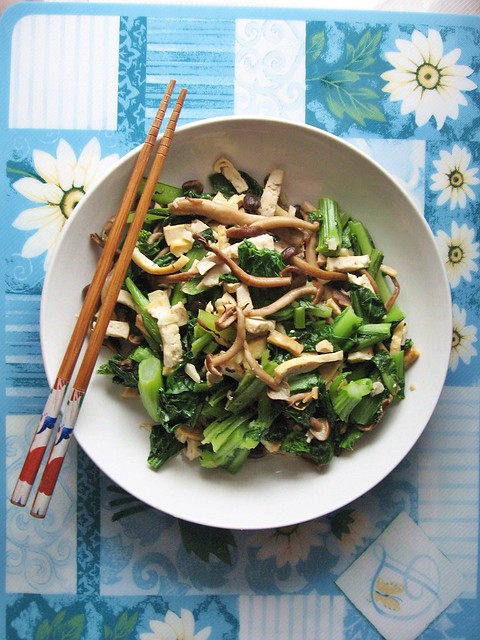
Stir-Fry Tat Soi Greens with Mushrooms Pioppini

Mildly sweet and earthy, Pioppini mushrooms remain firm and tender when cooked. As part of mushrooms Shimeji family, Pioppini mushrooms is rich in umami-tasting compounds.


If you find basic stir-fry of leafy greens and garlic too flat in flavors, mushrooms add good "meaty" flavors to a basic leafy greens stir-fry e.g. Asian Leafy Greens and Shiitake Mushrooms Stir-Fry


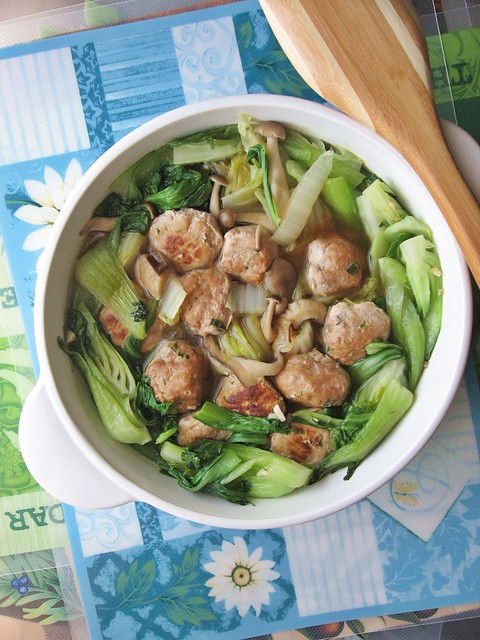
Chinese Lion's Head Meatballs Braise 红烧狮子头

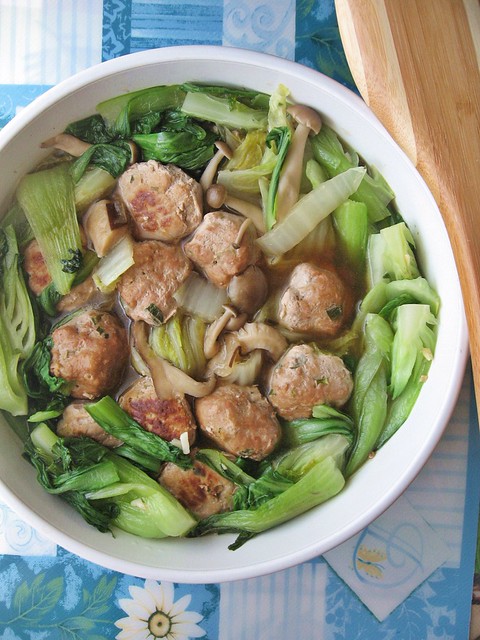
Isn't that just meatballs? Why is it called Lion's Head Meatballs 红烧狮子头? This Shanghai casserole dish has such a name because the typically over-sized meatballs is like the "head of the lion" braised with surrounding Napa cabbage that resembles "the lion's mane".

For the recipe today, I have tried to simplify the preparation and cooking, hoping to achieve a healthier yet delicious dish.


First, for those who avoids deep-frying at home, this lion head meatball recipe shares a over-roasted meatball version that eases up stove-top deep-frying. Second, the meatballs are of standard meatball size (not over-sized) so that cooking or baking time can be easily managed. For example, if you deep-fry a gigantic meatball, it takes a much longer time to cook through the meat compared to smaller meatballs.


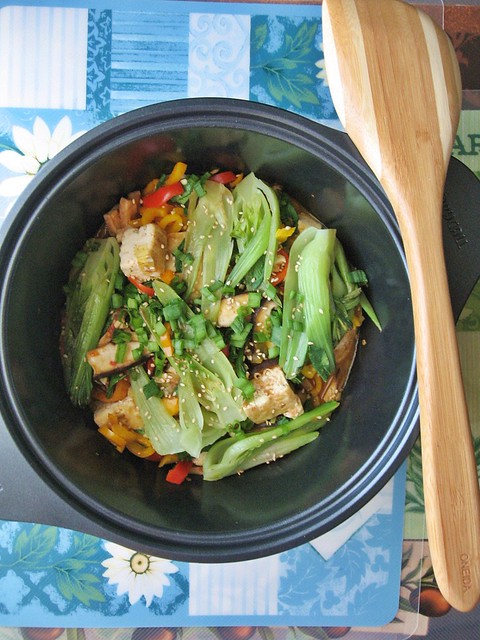
Vegetables Stir-Fry with Tomato Sauce 番茄酱清炒蔬菜豆腐

Excluding sesame oil, the only Asian cooking sauce stocked in my pantry is soy sauce. In Asia, most vegetables stir-fries call for oyster sauce but without that, I have to create some kind of "sauce" base when making vegetables stir-fries (e.g. Sweet and Sour Tofu Stir-Fry) and tomatoes come into the picture.

Tomatoes not only sweeten up the entire dish naturally, the combination of tomatoes and soy sauce just means more flavor (more umami) for the dish.


The trick to a quick Asian stir-fry of a combo of vegetables is to cook each or some of the vegetables" separately' then combine them in a quick stir-fry towards the end of cooking. If you were to add the vegetables - in the sequence of which vegetables cooks slower (added first), to those that cooks fastest (added last), the heat of the pan is often brought down when you add in something raw, thus slowing down the cooking process.

In this stir-fry, the tofu was pan-fried, set aside. Bok Choy stems were also pan-seared to soften, then set aside. Thereafter, the actual all-in-one stir-fry begins.


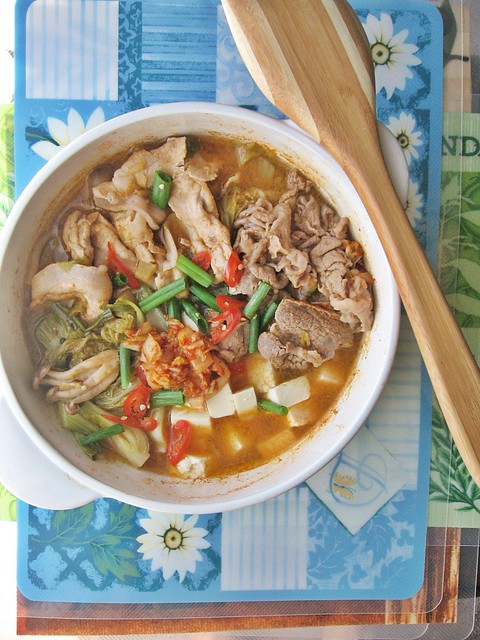
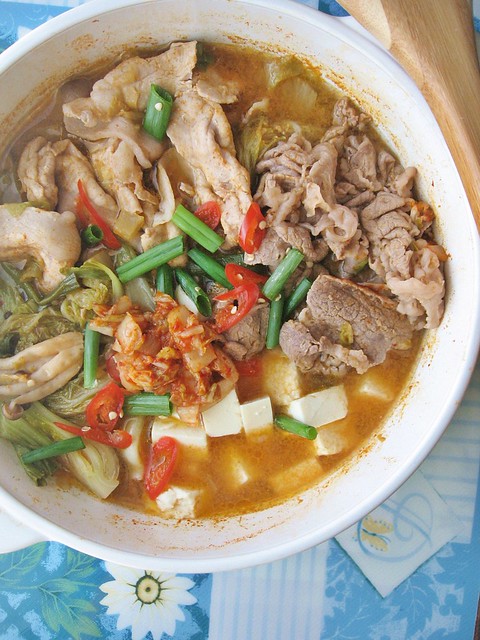
Homestyle Kimchi Jjigae 家常韩式泡菜煲

When I tasted my own kimchi jjigae for the first time, I thought "what is the difference between this and soon doo bu"? Both taste similar. Kimchi jjigae just belong to a bigger umbrella of jjigae variety - jjigae refers to a savory hearty Korean stew.


Traditionally soon doo bu is a spicy Korean stew cooked in a soup broth made with red pepper paste and red chili flakes and the main ingredient is soft tofu. Kimchi jjigae is a soup base made from kimchi, and a base so versatile layered with tofu, vegetables (e.g. napa cabbage, leeks), mushrooms, and seafood or meat.


There is nothing quite like coming home to a simmering pot of spicy stew in the cold winter months. The spice heat, and stew heat will instantly warm you up. Moreover, the kimchi base yields a subtly-sour soup that actually whets your appetite even more.


Korean Spicy Baby Bok Choy 韩式辣酱小白菜/奶白

After stocking my fridge with gochujang, there was a new-found motivation to create other Korean dishes in addition to bibimbap, then banchan came to mind.

These Korean sides-cum-appetizers including Korean Chilled Tofu and Korean Spicy Tofu, are not difficult to prepare, and complement very well with rice or noodles. With the right ingredients to "marinate" and flavor the vegetables, things look all set.


There came an opportunity to channel this urge of preparing banchan when there was some Nai Bai (also known as White-Stem Baby Bok Choy, a variant of Bok Choy) leftover from making soups and stir-fries. A kimchi-style Nai Bai it shall be as I have seen baby Bok Choy kimchi working out well over at LCOM.

Well, not all banchan need to be spicy e.g try making this non-spicy Sesame Broccoli or Sesame Edible Chrysanthemum (Shungiku).


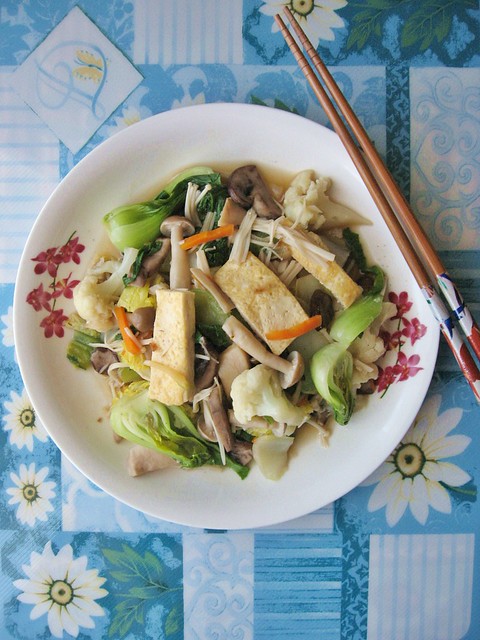
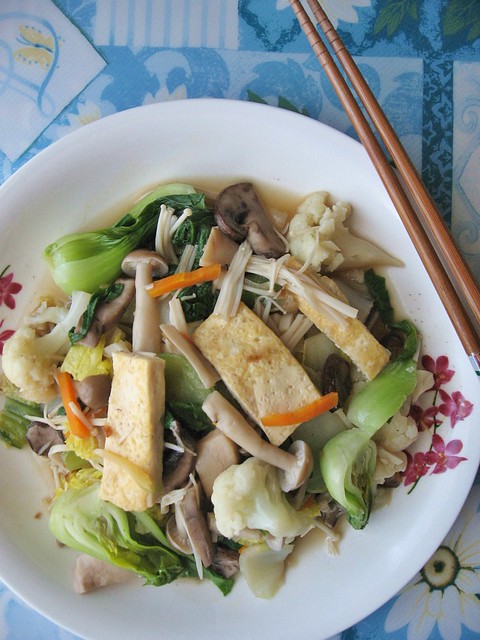
Napa Cabbage, Bok Choy with Mushrooms, Tofu 大白菜焖蘑菇豆腐

Is this a vegetable stir-fry or a vegetable braise? This dish leans towards quick and simple braising (in this context which means frying it quickly then simmering in a covered pot with a small amount of liquid) of  Napa cabbage with mushrooms and tofu.

Unlike Napa Cabbage, Mushrooms and Tofu Stew which can afford a little more cooking/simmering time, this vegetable dish should not be overcooked due to the presence of other vegetables particularly leafy greens.


If there are leftover vegetables such as Bok Choy, cauliflower in the fridge, they can be added to this dish and it will make quite a substantial dish; a dish that can be good enough to go solo or to pair with rice. With the addition of four varieties of mushrooms - oyster mushrooms, beech mushrooms, crimini mushrooms and enoki mushrooms, a vegetarian dish can be made very wholesome, nutritious, healthy and delicious.

The fancy name, often used in some Chinese restaurants, is Buddha's Delight 罗汉斋; otherwise it is also known as Combination Vegetarian Stir-Fry 什锦炒菜.


Bok Choy with Oyster Mushrooms 青江菜清炒鸡腿菇/杏鲍菇

Have you heard some folks saying that the leaves of leafy greens are harder to digest compared to the stems, so it is often recommended - NOT to have them in the later part of the day e.g. dinner? Try to have leafy vegetables for lunch, brunch or even breakfast; so in that way, there is ample time to digest all the good fibers throughout the day.


If the above statement(s) were true, then I would consume more leaves (of the leafy greens) in the daytime, and keep the stems for dinner. I wonder if that makes sense.

That would also mean if lunch was a quick and easy saute of Bok Choy leaves with garlic, then dinner would be the Bok Choy stems with mushrooms. Certainly, you can use the entire Bok Choy and not fuss over using the leaves and stems separately. This recipe is just an option or rather, a side-dish idea for those who are looking for new ideas.


Fresh Shiitake Mushroom Soup 鲜香菇小白菜汤

With homemade chicken stock (or even vegetable broth/stock), it was definitely easier to cook anything - at least, I did not have to wait too long for flavors to develop in a slow mellow-simmer soup or stew. This quickie Fresh Shiitake Mushroom Flat Rice Noodle Soup was put together in less than 30 minutes. Make it lunch or dinner!


For a quick-cooking soup like this, fresh mushrooms is usually my preference compared to the dried version.  The fresh variety has lighter flavors compared to the intense dried shiitake mushrooms which is often a better use in braised or stewed dishes, or typically in longer-duration cooking to develop the deep savory flavors from dried mushrooms.

Which do you use more often - fresh or dried shiitake mushrooms ?


It is not easy to find fresh shiitake mushrooms that are locally grown in the US and even if available, they do not come cheap (about $3 for about six to at most eight pieces of fresh shiitake mushrooms).


Baby Bok Choy with Oyster Mushrooms Stir-Fry 清炒蚝菇小白菜

Organic king oyster mushrooms are easily available in the Asian (be it Chinese, Korean, Japanese) supermarkets around the Bay Area, and I am lucky to have all these Asian supermarkets within close proximity.


Such a stir-fry of green vegetables and mushrooms is a regular at the dinner table, as it combines lots of vegetables and mushrooms (the protein) on a plate.

Stir-fry is a technique not so much on recipe. Basically, the essential step is to have all the vegetables prepped. (cut, sliced, chopped, diced, etc.) and ready (mise en place); then fry them in a sequence that "does good" to the vegetables e.g. vegetables that cook the fastest should be added last; while aromatics - onions, ginger, should always be sauteed first to "aromatize" in order to subsequently flavor up the vegetables.


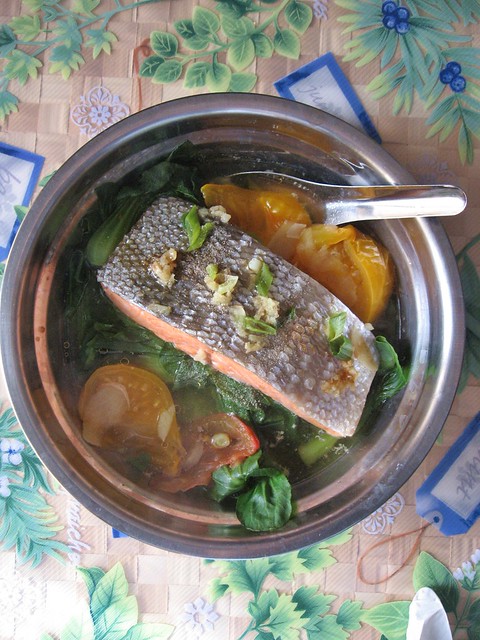
Steamed Salmon with Heirloom Tomatoes 白菜蕃茄蒸三文鱼

Ask me if using fresh fish is better than frozen in this steamed fish dish, and without hesitation, I would say FRESH! However, frozen salmon was all I had on that day, so I settled for "second best". I could have gone with en papillote (parchment-baked salmon) as I always do but the mind, heart and tummy was for a brothy soupy fish dish on this day.


This Steamed Ginger-Scallion Salmon Fillet with Heirloom Tomatoes and Bok Choy did not turn out as bad as one would have thought. It was also as easy to prepare as parchment-baked salmon.


The gingery and savory broth was well-complemented by the sweet hint-of-tangy flavors from the heirloom tomatoes and Bok Choy. One thing for sure, I would not mind having it again. In fact, I can't wait for peak heirloom tomatoes season to try this dish again!


Trio of Vegetables Stir-Fry - a battle of veggies!

This is a trio of stir-fry vegetables (organic baby spinach, baby bok choy and cabbage). No, I did not fry them altogether in the same wok at the same time. Rather, the vegetables were stir-fried separately - first the baby bok choy with garlic and ginger (without the mushrooms and carrots this time); then the baby spinach with garlic, finally cabbage with green onions, garlic and ginger.


Being the only vegetable that deserves some caramelization, the cabbage was cooked last and via a slightly different frying technique (also a longer cooking time) compared to the other two more gently sauteed vegetables.

The cooking is usually the easy task. It's the prep. (cleaning, cutting, chopping etc.) that takes time. Do you have this habit of mise en place (making sure everything is in order) when you cook?

Mise en place


Bok Choy Sum Stir-Fry 清炒白菜心

Usually, I prefer Bok Choy Sum to Bok Choy. With distinguishable dark green leaves and whitish stems, the former is "texturally crunchier" and taste relatively sweeter in an easy stir-fry like this Stir-Fry Bok Choy Sum with Garlic and Carrots 清炒白菜心


You need green onions (bottom white parts), ginger, garlic, and some carrots to aromatize the stir-fry, before adding the vegetables. You do not even need toasted dried anchovies and fried shallots to enjoy the light fresh taste of this stir-fry.


Bok Choy with Shallots and Anchovies 白菜清炒小鱼干

Mock me for not having oyster sauce in my pantry. How can I not have that? And call my cooking Asian (Chinese) cooking?!?!?! Alright, oyster sauce tastes good (makes food tastes good!) and is quintessential in Chinese cooking esp. stir-fries. However, I have "pledged" to reduce the use of bottled seasoning/sauces, especially those with ingredients that does not spell natural to me e.g. MSG as flavor enhancer, modified corn starch, caramel color.


Don't get me wrong. Not all bottled sauces are bad. I still use soy sauce (ingredients: soy beans, wheat, salt, water, sugar); sesame oil (ingredients: sesame oil); Chinese black vinegar (ingredients:  water, glutinous rice, salt); Chinese cooking wine.

But the good is: ever since I reduce the dependence on not-so-natural bottled sauces, I have learn to use natural ingredients to season and flavor as much as possible.

Let's say - without oyster sauce (the convenient tasty sauce), how then can the Chinese veggie stir-fry taste good?


Sometimes, a batch of fried shallots to flavor things up, keeping the remaining shallot oil to fry the veggies; while other times, fry up (and toast up) some dried "small fish" anchovies to add crispy fragrance to the dish.


Bell Peppers, Bok Choy and Mushrooms Pasta


Knowing a variety of cuisines helps me better my cooking. I try not to overcook the pasta, make sure it is al-dente and allow the pasta to finish off cooking while they are bathed in the pasta sauce in the pan. When it comes to Chinese stir-fry (esp that of vegetables), I do not like to overcook as well. So, when I combine both pasta and stir-fry vegetables, I only add the al-dente pasta when the stir-fry vegetables is just about 80% done, then finish off the rest of the 20% cooking of both pasta and vegetables...all in the pan. Makes sense?


Earth Day, 80/20 Diet, Stir Fry Vegetables

I saw "Vegetarian Recipes for Earth Month" somewhere at Whole Foods Market website and decided on my theme for today, coincidentally also Earth Day - 22 April 2010: Vegetarian Vegetable Recipes for Earth Month and Earth Day.

There are a few changes I have been making to my eating habits. I try to keep to a 80/20 rule (my food "decision-making" rule):
- 80 for vegetables-beans-whole grains-fruits(largely vegetables though) vs 20 for seafood/meat
- 80 for seafood vs 20 for meat

Stir-Fry Bok Choy and Napa Cabbage with Fresh Mushrooms and Carrots (Recipe below)

This change is 80 by chance (gradual habit) and 20 ("purposed") - probably because I stayed with my friend for about four months (her husband is a vegetarian) and we made sure there are always vegetarian dishes on the dinner table. Now I become really uncomfortable if there are no vegetables on the dinner table. And because they are a Chinese-Indian family, I am blessed with a good mix of Chinese and Indian vegetarian dishes.


Bok Choy with Carrots and Shitake Mushrooms

While to blanch a plate of vegetables is a no brainer, to stir-fry that same plate of vegetables does need a little more care and "heart" if you do not want yours to turn out of greasy and droopy, like what you get in some food stalls and take-outs. I love to use garlic - for aroma; carrots - for color; shitake mushrooms - for added nutrition and depth in flavor. While Mark Bittman, New York Times does his with shitake and oyster sauce (emphasizing on getting the real good oyster sauce and nothing artificial), how about you? How do you stir fry vegetables in the simplest flavorful way?


Bok Choy with Carrots and Shitake

Ingredients: bok choy, separate into stems and leaves, then cut the stems into smaller pieces; carrots, thinly sliced; shitake mushrooms, use caps and slice the caps into smaller pieces; garlic, minced; pinch of salt and white pepper

Directions: Add a little oil in a heated pan. When oil is slightly hot, add garlic and fry till fragrant. Then add in carrots, bok choy stems, mushrooms and fry briskly till slightly softened. Add the bok choy leaves, fry briskly. Cover the pan and allow it to simmer a while (so that the steam can cook the vegetables mixture). Stir fry thoroughly. If mixture is too dry, add in 1 -2tbsp of water. Add pinch of salt and white pepper, to taste.

Tag: , .


Bok Choy With Carrots and Shitake


A summer salad out of Chinese vegetables - it's all Choy Joy

Vegetables, 菜 (pronounced as Cai in Mandarin, or Choy in Cantonese) is the theme of Heart of Matter this round.

This brings me to the different varieties of Bok Choy seen in my nearby Asian supermarket in California. If you have seen names such as Bok Choy, Baby Bok Choy, Bok Choy Sum, Zen Choy, Tagu Choy, etc., wouldn't you be as confused as me? I got myself these three different varieties, and place them side by side for the benefit of you. Look (stare) - what differences or similarities do you see? Well, one has a greener leaf than the other; the other has a shorter stem than the next other - physically. I was so not familiar with Tagu Choy when I saw the name but... don't you find Tagu Choy a cross between the Bok Choy and Bok Choy Sum (Choy Sum literally means "vegetable heart"). See....the leaf of the Tagu Choy is the leaf-look-alike of the Bok Choy Sum (observe); and the stem of the Tagu Choy is the stem-look-alike of the Bok Choy (go observe again). Do you see what I see ?

That's my 2-min "tear-down" analysis for you (well, at least it took me two mins to type these out, and I "tore down" the individual leaves/stems for ease of comparison). Personally, I prefer the Baby Bok Choy Sum (Bok Choy Sum seen here), how about you ? I find them "sweeter" than Bok Choy and the green leaves are more "attractive" to me. Nutrition wise, I believe they should be quite similar to one another.
Other than the usual stir-fries that are seen here, here and here, I've done a Chinese vegetable salad this time (yes, I've heard some of you - summer-officially tomorrow, means less "over the stove top" cooking!) - Bok Choy Sum and Tomatoes Salad in Scallion/Ginger Dressing.

Ingredients you need and what to do with them:
1. Baby Bok Choy Sum - quick-blanched in water, then drained away excess water; when most water is drained, chopped the bok choy sum into smaller than bite-sizes
2.Tomatoes - cut into smaller cubes
3. Dressing: Spring onion and minced ginger in extra virgin olive oil . Basically, this is just mincing, and blending.
4. Mix items 1. to 3. and happy tossing!

TADA....this easy refreshing salad for you, if you wish to have a change from using romaine or green-leaves lettuce in your salad.

Tag: , , ,